Parallel Lines – Part One

9 comments
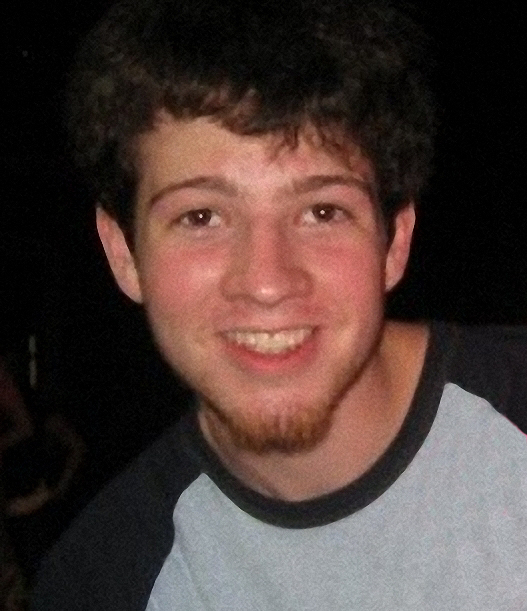
Jonah Maccabee Dreskin 1990-2009

Jonah Maccabee Dreskin
1990-2009

Dear Jonah,

It’s March 5th again. The third one since you left. And what’s on my mind this time is parallel lines. The ones that ran between your life and mine. It seems that you and I may have had a bit more in common that I’d ever realized.

I. When I was in the eighth grade, an unfortunate disagreement with my rabbi and his wife prompted my immediate withdrawal from temple high school, and a promise never to step inside a synagogue ever again. A year later, a young rabbinical student and his wife, (now Rabbi) Jonathan and Susan Stein, entered my life, offering me insight, encouragement and friendship as I navigated the choppy waters of my teenage years. I have no doubt whatsoever that at least part of the reason I became a rabbi was to thank them for all they did back then.

In the tenth grade, you had a similar disagreement with an English teacher, resulting in your immediate withdrawal from high school. But it would already be in the eighth grade that you’d meet Jill and Steven Abusch, who, along with Jeff Downing, would provide guidance and support for you throughout your turbulent teens. In large part, it is because of their time and attention that your life had become such a blessing by the time you turned eighteen.

I didn’t much notice this while you were alive, Jonah, but these past three years have brought to light a whole bunch of realizations about similarities between your life and mine. These parallel lines are stunning to me. And they serve as one more “meeting point” that allows me to keep your presence strong.

II. Spiritually, our paths were remarkably alike. You and I were both active not only in our temple youth group, but in NFTY (the North American Federation of Temple Youth) as well. Of course, while I became a member of the elected leadership, you would have none of that. You were quite content to do your leading (and you did) from amidst the masses.

In youth group, we both served as vice-president in charge of religious life. Which is ironic, since neither of us ever claimed traditional observance as part of our religious expression. In your campaign speech, you promised, “I will make sure to add a little something extra to services, something that will feel more like another program rather than a sit-down service.” Not surprisingly, you found services (your dad’s, I imagine) less than riveting and had wanted to stir things up a bit to make them better. Well, it turns out you and I weren’t much different on this count. You know what my favorite complaint is about my being a rabbi? That people never know what to expect at a Friday night service. It seems I prefer a noticeably creative element too. Like father, like son, eh?

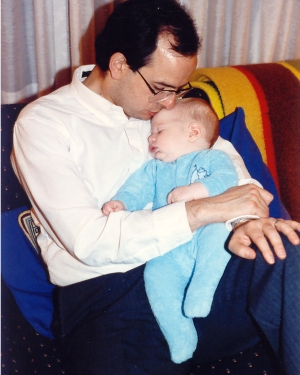
Jonah and Dad Early 1990

Jonah and Dad
Early 1990

III. Then, in our senior year of high school, even though we’d both been around youth group a long time, we were content to stick around some more, even if that meant being looked at as “the old man.” But it was comfortable there, and neither one of us was in a rush to go chasing new dreams. That would come soon enough. For now (then), we were just fine continuing to enjoy and to help build the program we’d each come to love.

IV. You never made it to the summer following your freshman year of college. But the plan was to return to Kutz Camp. You’d been there a long time and, again, were in no rush to do something new. You were going to work in the kitchen, which you’d have enjoyed tremendously. I too went back to camp (GUCI, in Zionsville, Indiana) the summer after freshman year. Actually, I had two freshman years, and went back to camp after each of them. You and I both loved our camps. There was time enough to set course for new horizons. We knew when we’d found something good, and we stuck to it.

V. Then there was the music, Jo. You were the better guitarist, but I was the better pianist. I probably sang a little bit better than you but not by much. And we’d both wanted to become songleaders. I did a fair amount of it in college, but you didn’t care for the preparation and so contented yourself with hanging out with your friends and pulling out a guitar (or a mandolin or ukulele) and singing along with people that way. So you were a songleader after all, weren’t you?

VI. Lastly, there was college itself. You started out at UB as an engineering student. It took about three breaths before you figured out you didn’t want that, and you switched to philosophy. I started out at University of Michigan as pre-med and felt the need to leave college entirely to sort things out. By the time I returned, music had become my major. Of course, in becoming a rabbi I kind of switched majors again … to philosophy.

Which begs the question. Would you have become a rabbi? Probably not. You’d likely have had the heart for it, but not the patience. Too much work. And we know how you felt about work.

But who knows? I always believed you could do anything you put that fantastic brain and soul to. Where you would have ended up, I can’t even begin to guess. I can only tell you that I was really enjoying watching you take the journey. Which made me even sadder when it came to an end.

I guess we’re all kind of lost during our high school years. And our job is to try new things, look for adults who care about us, and take that wild ride into the future that will (hopefully) bring us to the person we want to become. If that’s the case, then parallel lines run between all of our lives.

But something profound linked you and me, my son. I loved watching you grow. Perhaps because the kid I was watching wasn’t so different from me.

It’s been three years, JoJo. I still really miss you. I guess I always will. But I sure won’t forget you. That life of yours was something else. A little bit like mine. And a whole lot not. I’m glad to have been witness to all of it. It was a happening. And an honor.

Love you forever,
Dad

BillyParallel Lines – Part One
read more

Double Date

No comments

Valentine’s Day. Jonah’s birthday.

I always loved that the two went hand in hand. When he was younger, Jonah’s positive attributes were kind of difficult for many to see, but I did. And I’d always believed that he’d someday grow up to become a person who’d be easy to love. During his tumultuous middle school years, I would tell him, “Jonah, if you’d just show the world the sweet, kind, funny kid we get to see here at home, everyone would fall in love with you.” He always eyed me skeptically when I’d say that but, in time, he figured it out.

That big, playful, loving heart of his had room for everyone in it. And he was so good at opening it up. In our family alone, how many times did he (willingly!) help around the house, regale us with silliness that made us double over with laughter, give us gigantic hugs? I can only imagine how much moreso he did these things for others.

Our Forever Valentine February 1997

Our Forever Valentine
February 1997

I love that Jonah’s birthday fell on Valentine’s Day. When he was a little boy, I thought about how much his girlfriends would enjoy celebrating this day with him. Two for the price of one. So much romance in a single day. Once girls stopped being yuck, he’d agree with me.

That he only got nineteen of these very special days is a tragedy of course. But he wasn’t one to squander the good stuff, and once he got the hang of it, Jonah used every one of each year’s 365 days to share the beauty that was inside him.

I miss him, of course. As the memories grow more distant, I’m saddened to think they’re already fading a bit. But all I need do is think of the times he’d punch my arm, or squeeze the breath out of me, or just smile that magnificent smile of his … and my heart fills up all over again. Gone, but most definitely not forgotten.

Happy birthday, sweet boy. I may never have been your valentine, but you sure did win my love. Double.

Forever,
Dad

BillyDouble Date
read more

Path Change

1 comment

Dear Jonah,

Walking with Charlie through the woods behind the dog park, I find the path has grown more and more familiar from our almost daily visits this past year and a half. A quarter of a mile or so in, the path makes a hard right and heads toward a stream in which Charlie and many other dogs love to frolic. But the path is blocked by downed branches. It’s been this way since the heavy rains from last summer and the heavy snow this past October. We’ve all adjusted, making temporary detours, even clearing new paths, until someone makes things right again. But no one has. After all the waiting, it appears the new path will remain.

It dawns on me: that’s life after you. Having coped with so much debris scattered across and obstructing the pathway of our lives, it’s become increasingly probable that things will stay this way forever. You’re not returning. There’s no going back. This newly-cut passageway in our lives will remain.

Interestingly, as I approach the altered path and peer at it from some distance, it’s actually a clear shot down this new trail, from the place where it was blocked, across the fresh trail, and back onto the old path. The original path doesn’t even look right anymore.

Jonah’s portrait of Post-Katrina Disarray Ocean Springs, MS February 2007

Jonah’s portrait of Post-Katrina Disarray
Ocean Springs, MS February 2007

I think that sometimes we imagine we’re stuck, that obstacles and obstructions have sealed our fate, our failure. But the lesson here may be that if we can get ourselves to look at our new situation from a distance, with fresh perspective, we may find that the new path is just fine. We’ll be fine. Even if we remember for the rest of our lives how lovely the original path had once been.

As I proceed along this trail, I unthinkingly try to walk where fallen branches block my way, as if to say, “Nope. Can’t go that way. Not anymore.” So I turn, with a sigh, and as my feet find new steps to take, I’m somewhat surprised to find that it’s okay. The walk is still a lovely one, even if nature has changed it forever.

With you gone, Jonah, I find that the path has shifted forever. And it’s okay.

Sort of.

Love you forever,
Dad

BillyPath Change
read more

If You Can’t Go Home Again, You May Be Able To Go Back To Camp

No comments

Jonah’s camp experiences started as a one-year old when he began spending his summers as a “fac brat” at Kutz Camp (see “Kutz: A Human Symphony in Three Movements,” April 18, 2009). Ellen and I served on the Kutz faculty for more than two decades and our kids joined us for much of our time there. Our summers were near-idyllic. A safe community filled with high-grade humanity, a cabin on a hill overlooking (for most of our years there) a lake and acres upon acres of forest, all meals taken care of, and no dishes to wash. The work was exciting and fulfilling, and our kids lazed away their summer days spending the unhurried hours much like Tom Sawyer and Becky Thatcher did in an America one may have thought was long gone.

But lovely as those summers were, our lives were not our kids’ lives, and eventually each headed off to their own summers at Eisner Camp. From 1998-2005 (ages 8-15), Jonah typically spent one month on Faculty Row at Kutz and 2nd session as a camper at Eisner.

I suspect that, as with most parents, I won’t ever know much about what happened at Eisner. Jonah’s letters were the only real source of information, and brief as they were, not much came from there either. But here’s what I do know:

URJ Eisner Camp Summer 2004

• Typically, each of Jonah’s letters included a plea that we send “care packages,” sometimes asking us to hide food inside them so it wouldn’t be detected and at other times to definitely not send food. I compromised by sending only foods he didn’t like.
• One summer, Ellen gave him a legal pad to write letters home, but he couldn’t tear off the pages without mangling the tops of the sheets so we had to send a more manageable replacement. In one letter, he actually thanked us for that. Be still my beating heart.
• When he was eleven, Jonah wrote home about loving a Dan Nichols concert. This wasn’t so different from any other camper except that Dan would inspire Jonah to learn guitar and one day (when he was fifteen) play ukulele at Dan’s side during a concert at Kutz.
• Jonah fell in love with the “Magic” card game at Eisner. Each summer, he would come home and spend eleven months strengthening his deck to prepare for the next summer’s conquests. I have no idea if he ever won, but something (maybe a passionate vow of “I’ll get you next time!”) kept bringing him back to the table.
• We rarely learned what camp activities Jonah was involved in, but biking and football did get mentioned at least once in his letters. Jonah was never a terribly athletic guy, although I think he would liked to have been and therefore diligently tried everything. None of it persuaded him, chip off the old fatherly and slothful block that he was.
• The most pencil lead expended in Jonah’s letters was telling us of his excitement about two Tzofim unit plays he was in: Grease (2003) and Stars of David (2004). In Grease, Jonah played Danny Zuko. But more than having the lead role, Jonah was most proud of his “improvisational work” when another character had forgotten her entrance. Stars of David was a mock-talk show where Jonah appeared as the Jewish rapper Etan G and first debuted what would become Jonah’s signature presentation, “Makin’ A Motzi.” Boy, did he get traction from learning that!
• The Boston trip, of course, received enthusiastic attention in his letters home.
• But best of all for us, he let us know how much he liked having Katie and Aiden at camp. He even made sure to take a photograph or two with them.

But what will easily remain the most memorable (and infamous) Eisner moment occurred during the summer of 2001, Jonah’s fourth summer there. He wasn’t having as good a time as in previous summers and he dealt with it in a manner that may have surprised other parents if their own child had done this. We however had long before ceased being shocked when Jonah took matters into his own hands if he’d felt change was needed. Rather than work out any differences or disappointments, rather than find ways to make camp more satisfying and enjoyable, rather than actually tell someone he was unhappy, Jonah simply decided it was time to go home.

A smart one, my boy, he knew he’d have to get the support of Louis Bordman, the camp director, if his master plan was to succeed. So he simply adopted the following strategy: ignore anything your counselors say to you, never follow their requests or (eventually) their demands, and (as you’d planned) answer a summons to the director’s office. Shortly thereafter, he will call your parents and explain that camp just isn’t a fit and they should come pick up their boy. Which we did.

The next day, I wrote in a letter to Katie (who was probably still at Eisner): Jonah came home last night. He’s unbelievably happy being back at ol’ 25 Oak Street. He was so pleased to climb into his own bed and to wake up to cartoons and “real food” (as he calls it).

The following January, Jonah surprised us all again. He wanted to go back to camp. Well, we knew that would take some work. We accompanied Jonah into New York City to meet with Louis, who explained that what happened the summer before could never happen again. Jonah agreed and in a follow-up letter, he wrote, “I know what I did wrong last summer and it won’t happen again. I was having trouble talking and resolving conflicts with you and the other staff. I really want to go back so I’m going to try to be different. I’ll follow the rules, even if I disagree, and talk about it later. I’ll do what someone tells me and then tell someone about it, not refuse to do it in the first place. I’ll keep my anger to myself and get help if I need it. I will listen when someone’s talking to me and I will respond when someone asks a question. If I do something wrong, I’ll take the blame (but if I’m framed, I’ll try to prove I’m innocent). In a nutshell, I’m willing to change if you let me back into Eisner.”

That was Jonah evolving. Compliance without acquiescence. No promise of subservience. Just a willingness to not break teeth.

Jonah always had a powerful sense of justice that drove him to buck the status quo. As a child, he focused on his own “rights.” But as he grew into adulthood, he saw and he reached out to so many others he felt were getting a bad shake. Whether it was a kid getting picked on by bullies or a man he believed America needed as its president, Jonah was becoming a strong, caring, and activist soul.

That next summer, Jonah was allowed “back in” to camp and enjoyed another four summers there. As far as I know, he never got into trouble again. Well, nothing serious anyway. It’s been reported to me that, on occasion, he would run around Olim hill in his Simpson boxers without a care in the world. It’s also been reported that he kept a ready eye out for the well-being of others.

Jonah never again asked to leave early. As with so much of his life, he probably realized how good he was at making his own fun, and at making friends along the way. Who’d want to let go of that?

At the end of Jonah’s final summer as a camper at Kutz (2007), his bunk made a plaque that read, “We know everything.” There may, in fact, have been a few remaining lessons for Jonah to learn about life, but as far as camp was concerned, I believe Jonah did know everything. Given a second crack at making it work, my smart boy realized he had all the tools in hand. And he never looked back.

That was years ago. If you were among the throngs to meet Jonah toward the end of his high school years or in college, you know he rarely walked away from anything. Experiences like Eisner 2001 had taught him exactly what Ellen and I have always wanted our kids to understand: that life takes practice, and that we get better each time we’re willing to give it another go.

Had Jonah survived the night of March 5, 2009, I have every confidence he’d have learned exactly how not to let whatever happened that night not get the better of him again.

Billy

BillyIf You Can’t Go Home Again, You May Be Able To Go Back To Camp
read more

Art Touches Heart

No comments

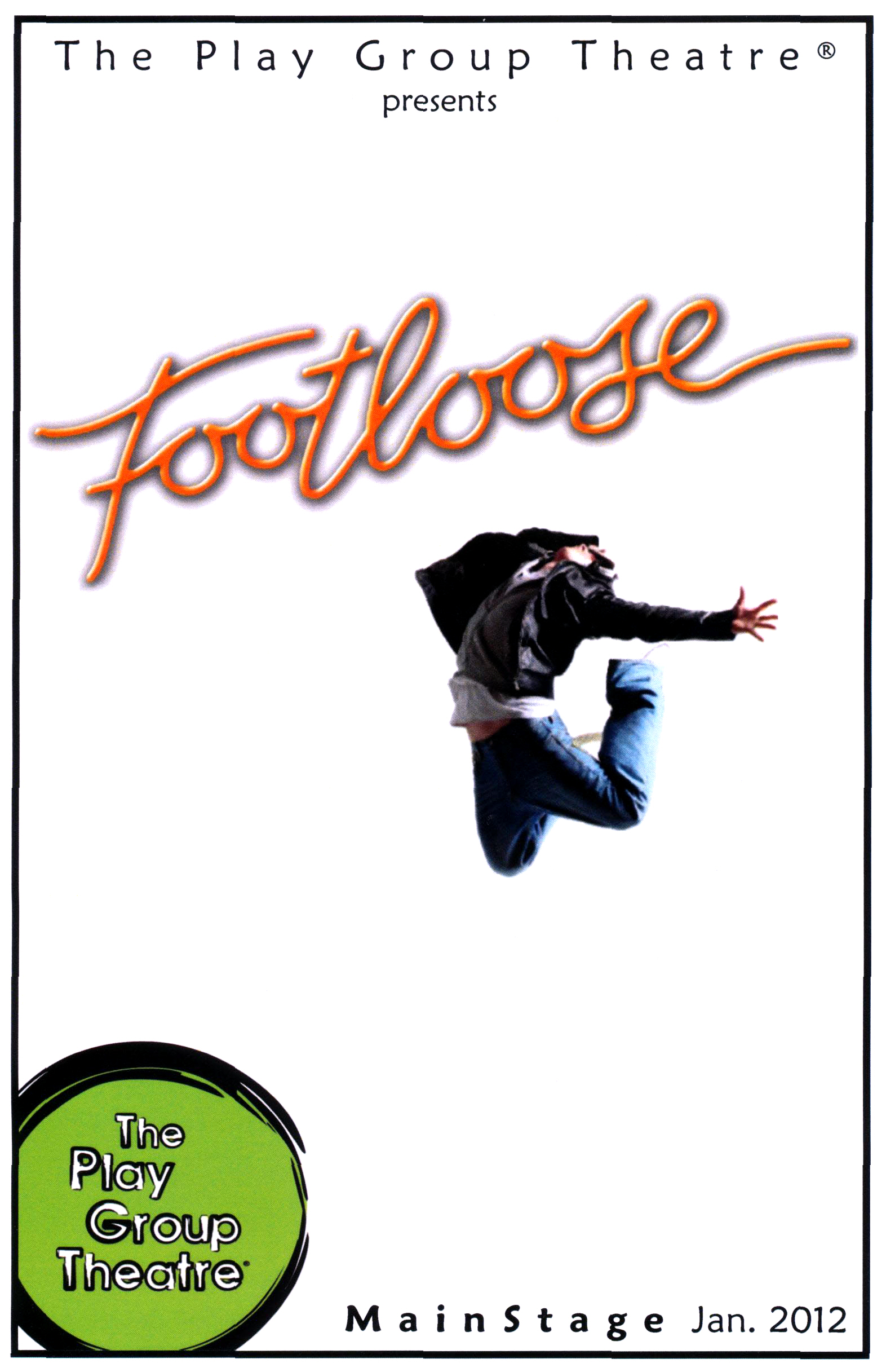
For the past two weeks, I’ve been driving into downtown White Plains, NY, to watch Jonah’s younger brother Aiden perform the part of Ren in the musical, Footloose. The show was produced by Play Group Theatre (PGT) which has been part of Aiden’s life since the 5th grade when Jonah introduced him to it. From the middle of 8th grade through the rest of high school, Jonah appeared in 11 shows at PGT, while Aiden has been in 11 shows, with a 12th and final production to open in June.

Theater looks for drama in order to tell a great story. Death, and its impact on the living, is often an effective avenue for tapping into some of life’s most authentically human moments. Our family, since March 2009, has not only traveled into this most difficult of realms but is now (and forever) sensitized to the nearly continuous presence of stories in our world that explore the human response to death.

While Jonah was in PGT, seven of his 11 shows involved the death of a main character. In an eighth production (Grand Hotel), he played a survivor of World War I who yearns for a final release from his empty, painful existence. And yet, despite the presence of death in these shows, we were innocent then and none affected us more than any other good story would.

Of Aiden’s 11 shows, death has also been persistently present. In the musical comedy, Urinetown, Aiden had his life beaten from him by an angry mob armed with toilet plungers. It was performed two months before Jonah died, and so we laughed. Of the six shows in which Aiden has performed since Jonah’s death, three of them have either brought Aiden close to death (as the title character in Pippin), actual death (as the title character in Bat Boy), or in relationship with someone else whose older brother had died (Footloose).

Watching the five performances of Footloose took me on quite a journey myself. Theater, when it’s good, draws us into a new universe and holds a mirror up to the more familiar reality of our own lives. As I watched the young woman speak of her brother’s death, I thought of my own daughter Katie, and what it’s been like for her to carry Jonah’s memory these past three years. I watched the girl’s mother, and thought of Ellen and what it’s been like for her to live without her son. Most startling of all, however, was watching Aiden play a character who admitted to not understanding what it feels like to lose someone you love, and knowing that he had been the one person onstage who knew exactly what that feels like.

And then there was the father of the boy who’d died. His character was a clergyperson. And a decent guy. And someone who still felt the pain everyday of his son being gone. As I watched each performance, thoughts tumbled around inside of me. Have I been a good parent to Katie and Aiden since Jonah’s death? Have I been a good husband to Ellen? Have I been a good rabbi to my congregation? How has Jonah’s death affected my relationships? And what of the future – how will his death continue to impact my heart and the way I live my life?

Footloose wasn’t supposed to be the most moving story ever. It seems as if the script first and foremost provided opportunities to sing some fun songs and to stage some great dances. PGT performed admirably in those areas; their five audiences loved being there. But for me, and for anyone else sitting in that theater who has either lost someone they loved or knows someone who has and who happened to be sitting there as well, Footloose told a second story – that of a continuing journey which I don’t think can ever be completed. I live on after someone I loved as dearly as life itself has died. That loss seems as if it will never completely go away. At best, it will be integrated into a still joyful, though now nuanced, life that understands more than I ever cared to about the best and the worst that existence sends our way.

As I watched my son Aiden act and sing and dance, Footloose carried me heavenward on wings of love and of pride. While I was up there, I think I caught a glimpse of my son Jonah who each day carries me on wings of love and pride, as well.

When Jonah was in The Laramie Project in 2005 (this time, he didn’t die; he just played the murderer), I placed an ad in the show’s program which included a quotation from 20th century author Thornton Wilder, who penned Our Town and The Bridge of San Luis Rey. Wilder had written, “The theater is supremely fitted to say, ‘Behold, these things are.’” In a note to Jonah and his fellow cast members, I added that theater “shows us the tragic state of how things all-too-often are” and challenges us “to create what needs to be.” I was so proud of Jonah for being part of something that was trying to better us all. I am so proud of Aiden for doing the same.

Billy

BillyArt Touches Heart
read more

Sacred Ground

1 comment

A few days ago, I was out at Sharon Gardens Cemetery.  For work.  I know it sounds bizarre, but what can I say?  I go where my people are, and on that day they were at the cemetery.

When I was finished, I stopped by Jonah’s grave.  It’s kind of weird, of course.  Questions come to mind.  Is he there?  Do I say hello?  But what was most unsettling for me was the difficulty I had in finding a stone to place on his marker.  All I needed was a tiny pebble.  But in a Jewish cemetery, such things have long ago been claimed by others.  To go looking is a bit of a fool’s errand.  Nevertheless, I milled around looking for one that had maybe burrowed its way up from underground, perhaps pushed up by the recent rainfall.  All I knew for certain was that I couldn’t very well steal one off another grave.  It’s not that I didn’t think about doing it.  But I was worried I might get caught.  Worse than by the living, I might be caught by the dead (cue creepy music).  But that’s me.  My imagination tends to get the better of me.

I had the perfect pebble at home.  I’d brought it home from Kutz Camp this summer.  I’d been given it in a program and asked to write something on it to leave behind.  Well, once I’d written Jonah’s name there was simply no way I could leave the pebble behind.  I brought it home with me.  But I could maybe leave it at his grave.  Maybe next time.

I finally located a stone that seemed available (i.e., without moral repercussions) and I left it there.  Mission accomplished.

If I sound a bit flip about this, it’s because, while it’s certainly still sad to go to Jonah’s grave, it’s definitely not as emotionally wrenching as previously.  Jonah’s body has been in the ground for two and a half years.  That’s a long time.  I imagined what was left of him down there (cue more creepy music?) but I didn’t feel particularly emotional about it.  If anything, it became almost a non-event because if Jonah’s body is gone then what’s the big deal about being there?

Still, it’s sacred ground.  And I most definitely acknowledge that. The ritual of the pebble attests.


Elmsford Reformed Church & Cemetery Stuff of Memories, circa 2000

Elmsford Reformed Church & Cemetery
Stuff of Memories, circa 2000

On the way home, I drove by the Elmsford Reformed Church on Route 9A.  It’s a road we’d drive often, passing by the Revolutionary War cemetery at the church and, one day, stopping in.  Parking the car, Jonah and I spent some time looking at the 200-year-old markers whose letters were so weathered as to be nearly illegible, and whose stones frequently lay flat to the ground, long ago abandoning their assigned task of announcing to all who lies in eternal rest there.  Jonah must have been about ten at the time, and he’d really been fascinated by this little cemetery.  I think he considered our time there to have been a memorable event in our shared lives.  I know I do.  And it’s become a peculiar anchor for my remembering him.

But hey, two and a half years after his death and I’m still grabbing at every memory I can drag out of my brain.  It hasn’t been that long.  I still really miss him.  And if I can find a way to feel (even just a bit) his having been in my life, I’ll take that road.

Billy

BillySacred Ground
read more

Putting On A Brave Face

No comments

I read an article in the New York Times this morning about how a plastic mask used for protests across the world has also created some significant income for its owner, Time Warner (“Masked Protesters Aid Time Warner’s Bottom Line,” New York Times, August 28, 2011). The mask is a haunting one, both because of its design and because it’s hanging on the bedpost in Jonah’s room.

After Jonah died, one of the conduits of information about his life has come from his camera. Jonah took a lot of pictures. Hundreds of them. Usually, I’m able to recognize Jonah’s friends and the places or activities being logged. But one set of photographs from April 2008 (Jonah’s senior year of high school) eluded me. Not a single face was familiar, and I couldn’t understand why this group was hanging around outside the Church of Scientology offices in Manhattan. And why the masks?

This mask from Jonah’s high school days went to college with him too.

This mask from Jonah’s high school days went to college with him too.

The mask, it turns out, was the giveaway. An organization called Anonymous, founded in 2003, engages in acts of civil disobedience, protesting perceived injustices, and keeping their identities hidden along the way. They have taken very active stands against racism, sexual predators on the internet, AIDS-related bigotry, the Church of Scientology, and even the election of Iran’s President Mahmoud Ahmadinejad.

During Jonah’s senior year, I knew he’d been traveling into New York City from time to time. But Jonah was a gregarious guy and I just figured he was meeting friends there. Anonymous, however, had caught his eye and his heart. I think he loved the clandestine nature of it, and I know he appreciated working to better the world. With his creepy Guy Fawkes mask, he’d found a way to do it in a manner that suited his own quirky but sincere personality.

While Time Warner has enjoyed the profits from sales of the mask, Jonah profited from something much better — the satisfaction that comes from having joined with like-minded people who try to do something good for the world around them. I can’t help but wonder where such activities may have led him, but what remains is my pride in a young man who saw himself as part of a larger world that benefitted from his concerned efforts to improve it.

Billy

BillyPutting On A Brave Face
read more

Won’t You Look Down Upon Me, Jesus?

No comments

Today, at 6:00 pm, Christian millennialist believers were supposed to have been “raptured” – lifted up to heaven to live side-by-side with Jesus until he brings them back to earth to do final battle with the anti-Christ for the salvation of the planet and its (faithful) inhabitants. Needless to say, 6:00 has come and gone – no one made any spectacular departures.

But I know something about these beliefs.

The world is a hard and tough place to live. So much must be endured. It’s not at all surprising to me that there are those who look beyond human efforts, hoping for a powerful ally to intercede and save us. In Christian theology, the saved would be those who have accepted Jesus as their savior. How comforting for them to know that, if they’ll remain steadfast in their belief, something much better will come.

Comfort is something I think we all yearn to have.

Since the day Jonah died, I have explored – in the hope that I might find my son still alive in some “beyond death” kind of way – new ideas about the afterlife and even about resurrection, ideas not unfamiliar to me but, until March 5, 2009, I had no great need for any of them to actually be true. Two years after Jonah’s departure, my heart continues to endorse my exploration of anything that might bring my boy and me back together. Even the psychic medium, John Edward, appeals to that voice inside me that’s crying, “Please, help me find him.”

But while my brain says, “You don’t really know that any of this stuff isn’t true,” I was brought up as a skeptic and so I bite my tongue to stifle my snicker at the same time I do my exploring.

Just the same, the heart is a powerful motivator. These millennialist folks just want the world to get better. And I just want my boy back.

Neither of these is very likely to happen. But unlike the guy who sold his home for not very much money as he went off this morning to meet his maker, I’m not stocking up on Jonah’s favorite foods.

Nonetheless, that heart of mine doesn’t let me forget how much he liked Easy Mac.

Billy

BillyWon’t You Look Down Upon Me, Jesus?
read more

6:01

1 comment

It’s hard to say when Jonah fell in love with music. I suppose that, for most of us, melody serves as a fairly constant backdrop to our lives. It first consists of the tunes our parents or older brothers and sisters play, but then sometime along the way, we begin to want to make our own selections. I remember when I was maybe ten years old, and my brother Michael bought me a record player for my birthday. It was like he’d given me my first razor (which, actually, he also did) or taken me to my first R-rated movie (my mom did that). It felt like such a grown-up thing for me, to have the capacity to select for myself the music I wanted to listen to. Of course, for a while, I could only choose from what I’d been exposed to, so it was pretty much still my family’s music. But eventually, I began picking out tracks and albums for myself.

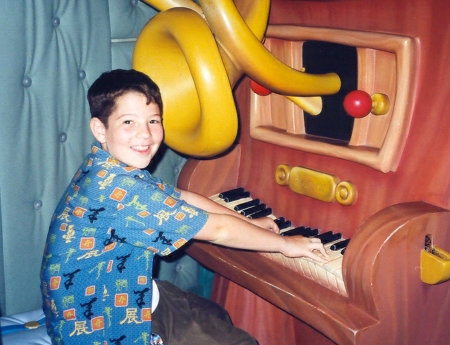
Disneyland 2001 – age 11 (he knew)

So witnessing my own children’s musical maturing was a sight to behold. After endless listens by all three of the kids to the Animaniacs’ Variety Pack and Mickey Mouse unRAPped, Katie was of course the first to break out of the pack, with Hanson’s Middle of Nowhere. Aiden’s pretty sure his first choice was a collection of alternative rock hits called Buzz Cuts that he had me order for him through the mail. But Jonah’s first is a mystery. It’s the kind of question that pretty much has to be answered by that person, sometime before it becomes ancient history which they themselves have forgotten. And of course, sometime before they’re gone altogether. Not much I can do about that.

Me, my first music purchase was the soundtrack to Mary Poppins. I remember it so well. Grandma Mollie had sent me a five dollar check and after writing her a note in which I promised to spend it wisely, I went out to Walgreen’s with my dad, found the album in a display rack, and brought it right home. There had been no doubt in my mind but that Mary Poppins needed to be the first LP that I would own.

There are other early music memories. Katie told me about when she and Jonah would listen to Footloose in the basement. They’d dance while wearing rollerskates; only, Jonah thought that dancing included throwing things, which of course infuriated Katie. But since when did Jonah ever do things the way others wanted him to?

So I’m left with this mystery. And while I doubt it will ever be solved, I do remember one of the very first CDs to appear without parental intervention was Great White North, a collection of comedy bits by Bob and Doug McKenzie. Figures, doesn’t it? In time, Jonah would come to own as much rock music as the next teen, but there’s poetic synchronicity to his first recording being a comedy. I’d already loaded him up with the favorites of my own youth. Smothers Brothers, Bill Cosby, Tom Lehrer, Allan Sherman and Steve Martin. It probably comes as no surprise to anyone who knew Jonah that these would be at the foundation of the sonic experiences of his youth. Or that I had deftly guided him from very early on in this fine cultural legacy. Such a proud dad!

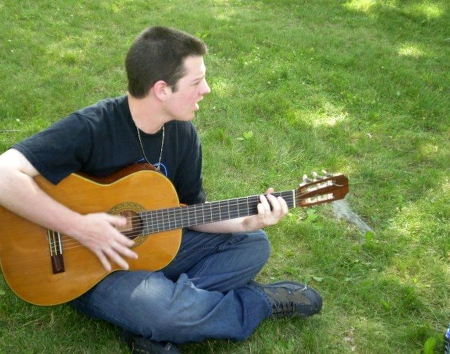
In time, listening to music would be insufficient for Jonah. He needed to make music for himself. My guess is he admired his songleaders at Eisner Camp and figured if they could be at the center of a crowd because of a guitar, why couldn’t he? So in July 2002, at age 12, he asked me if I would get him a guitar. Typical dad that I am (i.e., cheap), I responded by finding him a $25 guitar on eBay (it was actually a $12 guitar, plus $15 shipping … unbelievable). “Learn how to play that, JoJo, and we’ll talk about getting you something better.” He took me at my word. In a school project just a few months later, a timeline of his life from 0 to 13, Jonah wrote, “Just recently, I learned to play the guitar. It was a big step because pushing down on the strings and moving my fingers so quickly, it hurt my hands. But millions of people on earth and even just in America were able to learn the guitar and I am too. I’m not very good but over time, I’ll practice and become a professional.”

The first song Jonah learned was “The Irish Ballad,” a rather peculiar little folk song written by Tom Lehrer, about a young lass who murders (fairly brutally) everyone in her family. That would, once again, be my Jonah’s sense of humor.

Needless to say, he became pretty darn good. A year later, Jonah got that second guitar (a Martin backpacker). And two years after that, his red Dean acoustic. In time, he’d add an electric guitar, a second electric guitar, an ukulele and, finally, a mandolin. If you want to learn more about Jonah’s guitar interests, read Pick Pocket (June 15, 2009).

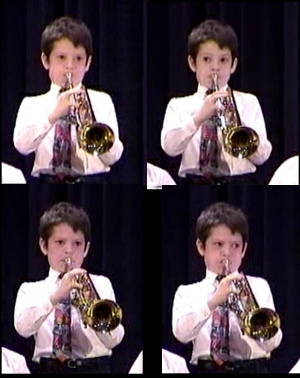
Trumpet Stylings Age 9 (1999)

Trumpet Stylings
Age 9 (1999)

For a while, though, prior to his guitar strumming years, Jonah was known as a horn player. He took a couple of years of trumpet lessons when he was 8 years old. Our good friend Josh Davidson gave Jonah the trumpet from his own youth. They shared a sweet bond through it because the case had Josh’s initials embossed there, which turned out to be Jonah’s as well. Nonetheless, Jonah couldn’t fathom using Josh’s mouthpiece because “it must be covered with millions of disgusting germs.” While I assured him he could use his own mouthpiece until he was sure that Josh’s was safe, Josh wrote Jonah a note reporting that “any cooties have long since died.”

In time, trumpet would give way to shofar. And for a number of years, starting at age 11, Jonah could be found standing between his mom and his dad at the kids’ services on Rosh Hashanah blasting away. More than a few kids were inspired to learn the shofar for themselves because of Jonah. If you want to read more about Jonah’s horn-period, take a look at Sweet Toots (May 24, 2009).

In one of Jonah’s college applications, he wrote, “Guitar … know how to play it, or love someone who does.” When I was young, my brother Tommy was the guitarist in a local high school rock band called the Dauphin Street Blues. A few recordings survived those years (the late-1960s) and eventually found their way to a home-produced CD which I got my hands on. Jonah loved the CD, mostly because it was his Uncle Tommy who played on it. I always found it touching that he loved listening to these particular recordings. I too was always enamored of Tom’s playing, and it warmed my heart to see that his nephew was, as well.

In Jonah’s University at Buffalo application essay, he wrote, “I could never choose a favorite band, or a favorite song, because everyone has something to offer.” I never knew how seriously he took this sentiment until his iPod came home in March 2009. Of the eclectic collection of writers and performers he had gathered, none surprised me quite so much as the pieces by Tchaikovsky that I found there. Where had he encountered Tchaikovsky?

I actually wrote to some of his friends to see if they could shed some light on this question. One of Jonah’s freshman year buddies, Tracy Questel, wrote back, “This isn’t surprising to me that Mac would listen to Tchaikovsky since his music taste was so widespread and grand.”

Kutz – the Jerusalem of Music Summer 2007

Apparently I’m not the only one who thought so. Of course, this was reflective of the way Jonah lived his life. No one and no experience was outside the realm of interest or possibility for him. He loved tasting so much of what the world had to offer. I think it’s one of those comforting factoids about him that help me feel like his nineteen years, though brief, were full.

I listened to Jonah’s Tchaikovsky collection. It’s really some spectacularly gorgeous and powerful music. One particular piece — from Act II of Sleeping Beauty, “Pas d’Action, Adagio,” a 6 minute and 1 second recording — moves me so very deeply. While listening to it in the car one day, I was stunned by the “feeling of Jonah” that swept right through me. This music contains so many of the elements of Jonah’s life: his power, his drama, his fullness of spirit, his beauty, his emotion. I couldn’t believe how perfect a musical metaphor it is for him.

So while Tchaikovsky seems like a curious choice for a rocker like Jonah, it’s actually quite perfect for the huge personality he had. Finding it on his iPod was like a parting gift he’d left for us.

During Jonah’s junior year of high school, he put together a Shabbat service for the NFTY-NAR Winter Kallah in which he included the following words of Martin Luther: “Nothing on earth is so well-suited to make the sad merry, the merry sad, to give courage to the despairing, to make the proud humble, to lessen envy and hate, as music.” If ever there was a person who followed his own heart in this world, it was Jonah Maccabee Dreskin. What was so magically wonderful about him, though, was that his heart, as irreverent as it may have seemed, was so attuned to the music of other people’s lives. Jonah wrote at the back of his UB planner: “Life is a stringed instrument. When our wavelengths meet, we are a chord.” I think he really believed that, and he tried each day of sweet, brief life to create a symphony of kindness and love.

One more thought. During the summer following Jonah’s death, we were invited to a presentation in Jonah’s memory, a tribute to Jonah, by the children of Play Group Theatre. In it, they sang for us the old Barry Mann-Cynthia Weil hit, “Make Your Own Kind of Music.” My Jonah, who appreciated the music that so many had to offer, and who mastered any number of instruments which allowed him to offer music of his own, brought a melody into this world that sang itself through Jonah’s every waking hour. Those who were lucky enough to get a ticket to this performance found their lives enriched by the time they spent with the quirky kid with two names. He didn’t always believe his song was one that people would want to hear. But over time, I think he learned there was music in his soul that needed no guitar or ukulele — just a warm smile, a kind word, and a sincere willingness to be a friend.

By the way, as I finish writing this piece, IZ’s recording of “Over the Rainbow” has begun playing on Pandora. Jonah’s signature piece. I miss my boy so much. And I’m so very thankful for the incredible music he’s given us all.

Billy

Billy6:01
read more

Death and Rebirth of the Spirit

1 comment

I guess I don’t get out much. I mean, I’m at work so much of the time. But when I’m not there, I’m pretty much at home. Part of it is I’m a busy guy, and there’s always temple work to be done, even at home. Part of it is I’m a busy guy, and when I manage to steal some time away from temple, I want to be with my family. But part of it is also that I’m a couch potato. And whether it’s a television or a computer, I keep myself infinitely entertained in front of electronics.

So besides work, my home is my world. Norman Corwin, a writer and producer of radio drama during the 1930s and 1940s, described home life in this way: “A home is a minuscule world. If it has 10 books, it is partly a library; if three pictures, a little museum; if six tools, a repair shop. If one big crowded closet of bric-a-brac, a warehouse. Whenever a piano or fiddle is in use, it is a part-time conservatory. At mealtime grace, or in answering a child’s question about God, it is a fraction of a church. In the throes of argument or the heart of discourse, it becomes a court; in sickness, it is a field hospital; when you discover old forgotten letters, pictures, souvenirs in a trunk or attic, it is a wing of archaeology. [And] when the kids climb trees, fences, high furniture, or other forbidden obstacles, it’s a commando camp.”

That pretty much describes the bulk of my world.

Every autumn, looking outside the windows at 25 Oak Street, or while driving from there to temple, I always think about how much I’d like to take that drive that has no other purpose than to watch the leaves turn from green to golden. But since the thought always comes at the busiest time of our temple year, I never seem to get that chance. So year in and year out, the seasons change and I’m only a partial witness to its dramatic shifting of the backdrop to our lives.

Then along came Charlie. Charlie is a medium-size beagle/basset hound mix, who came into our lives last July when we adopted him from the nearby Elmsford Animal Shelter. From the day he arrived, life changed. Four times each day, Charlie goes for a walk. If he doesn’t, there’s a price to be paid. Carpets get peed on. Furniture gets chewed on. Family gets endlessly pestered. So Katie takes the early morning walk. Aiden takes the late afternoon walk. I get lunch and nighttime. But as often as possible, I open the back door of my car, Charlie jumps in (the only time, by the way, when he’s off-leash and doesn’t shoot down the street or into the backyard in a bold and dramatic escape), and we head over to the East Rumbrook Park dog park.

There are two sections to the dog park. The first is a fenced-in area where people and dogs mill about chatting about all things dog (the people, not the dogs), and sniffing one another’s rear end (the dogs, not the people). Behind the fenced-in area, however, is a moderately large woods where, although I believe it’s officially unallowed, dogs can run off leash, often frolicking with one another and playing in the stream (probably, I suppose, named Rum Brook).

The walk from the front to the back of the woods takes about ten minutes, ten minutes to come back, and anywhere from ten to thirty minutes inside the woods letting Charlie run around. It’s in these woods that I have been afforded the opportunity to watch something I’ve never truly watched before. Namely, the changing of the seasons. Walking the same path again and again, I’ve watched this one landscape progress from last summer’s heavy foliage, to autumn’s color changes, to winter’s bareness, and now, the woods’ reemergence into its former summertime glory.

Winter was remarkable. Since all summer long, I had been losing Charlie as he disappeared into the ground cover which rose just above his body, it was quite incredible to walk into the woods after what appeared to be God’s picking up the toys and vacuuming the floor. With the ground clear, I could watch him run almost the entire woods, never losing sight of him (except the time five deer came prancing by and Charlie pursued far beyond what my eye could follow).

In the past couple of weeks, I’ve been witnessing nature’s remarkable return. One which we all see, but might not truly take notice of, except for a brief moment or two when buds appear on trees or the season’s first flowers bloom. We may smile a bit or even comment on it to a friend. But in the woods, everything happens in bulk. Tiny green chutes emerge from the woods’ floor, but there are hundreds and hundreds of them. Buds appear on the trees that accompany me the entire length of that wooded journey. Even the moss, which has begun to grow on rocks near the creek, becomes a spectacle in that formerly barren chamber. And then, when Charlie and I return only a few days later, the progress nature has made is dramatic.

And all of it puts a smile on my face.

I’ve been thinking about this return of nature from winter’s sleep. Witnessing what appeared to be dead, and watching it move through its rebirth, has affected me deeply. I’m just a bit more than two years out from that terrible night in March of 2009 when the phone call came from Buffalo that my 19-year-old son Jonah had died. Having now experienced two full cycles of the seasons and, in particular, having watched this progression from Charlie’s arrival in July until now, my heart can’t help but pose the question: If so much of nature can come back from the dead, why can’t my child? I certainly know it won’t happen, but nature doesn’t offer a whole lot of comfort when it seems to be renewing itself all the time.

But that’s quite the point, isn’t it? Nature doesn’t really die, even if it appears that way. The top, outer surfaces drop off in order to conserve energy through the winter months, but everything is very much alive beneath the surface. Not so my Jonah. Dead is really dead, I’m afraid.

Grieving has quite a learning curve to it. While at one point or another, everybody does it (and more than once) not many of us get any training beforehand. So our heads try to rationally understand and respond, probably making more than a few correct choices along the way but a few poor ones as well. And our hearts … well, our hearts just go nuts on us. 52 years of careful theological decision-making thrown out the window as feelings trump logic and I foolishly (but touchingly) await my Jonah’s return.

Colorado.1992John Burroughs, early-20th century American naturalist, stopped by to visit a woman who had become an ardent admirer of his writings. Well aware of his love for winged creatures, she asked, “Why is it, Mr. Burroughs, that there are so many birds at your place? I have none at all in my yard.” Burroughs, who had been watching, in absorbed fascination, all sorts of birds, flitting amidst the shrubbery and flying among the trees around the lady’s house, replied, “Madam, you will not see birds in your yard until you have birds in your heart.”

And so, I discover that perhaps I’ve been looking for the wrong rebirth. Or, at the least, I may have been looking in the wrong places.

The return of ground cover, leaves and lichens to the woods of East Rumbrook Park may have a message for us all about what appears to be, the disappointment which accompanies what isn’t, and the eventual comfort that arrives along with what really is. Surely something died in the woods this winter. And everything that is coming back will do nothing to regrow what can never again be. But despite that loss, everything that is coming back offers abundant beauty and comfort for the journey that follows loss. I will never be able to bring Jonah back; he has died. But my heart has not (even if it sometimes feels like it has), and it is very capable of a new greening, of a new blossoming, of what appears to be rebirth but is, in fact, an awakening from the winter’s sleep of sadness which began two years ago.

I am not, of course, alone in the difficult struggle to carry on that often accompanies a tremendous upheaval in life. Others, more than a few right here in this room, have lost a loved one, or lost robust health, or lost economic well-being, or lost a dream held close which has faded or been torn away. Often (too often, our hearts cry), we are forced to give up some piece of our lives that we have cherished, and without which we simply don’t know if or how to resume. But, as John Burroughs noted, the birds of joy and beauty have likely not abandoned us; if anything, we’ve abandoned them. We lack, or have lost, the tools to welcome them back into our lives. Our task, should we desire to resume contented, jubilant living, is to readjust our sights.

In thinking about all of this, I was reminded of Moses and the Burning Bush – that, in the desert, dry bushes, usually ignored, even when aflame, don’t draw our attention. So why was it that Moses watched this one? And further, how long does one need to watch a burning bush before we sense that it may be burning but it’s not burning up? Moses must already have been on the lookout for God’s presence, and he must have been ready to detect that presence anywhere. Even in a homely, non-attention grabbing, dried out bush.

Death is dramatic. It draws our attention. Renewal is much quieter. It doesn’t grab headlines. And if we want it, we’re probably going to have to come looking for it. “Mindfulness” is a word my friend Corey Friedlander often uses. It’s a fine word, and one we might all benefit from using. My walks with Charlie have made me more mindful of the turning of nature’s wheels. That has been quite wondrous to see, and I am grateful to be part of such a world. And just as I take frequent walks through the woods behind the dog park, I think I need to take more frequent walks through those other wooded areas in my life. I too wish to hear the birds sing in my backyard.

We’ll soon be sitting down to our Pesakh seder tables, where we’ll retell the ancient story of our people’s emergence from the narrow places of Mitzrayim. And we’ll remind ourselves that “tight spots” exist in every age, ours included, that we ought not resign ourselves to servitude, that we ought to feel ourselves worthy of liberation. And whether our burden is from the challenges of health, of finances, of relationships, or of existential despair, this holy festival comes around each year – just as springtime is renewing the world outside our homes – to remind us that renewal can occur within, as well.

Dead is probably still dead, and I have to keep working to come to terms with that. We all have to keep working to come to terms with loss. But in a world where good never, ever fully disappears, there is so much that is worthwhile, worth celebrating, worth living for. The tremendous variety of food and of ideas that we find on our Seder tables. And the even more precious variety of human bonds and spirit that we can find around those tables, these are the building blocks of rebirth. It may be that such activity is easier for nature. Because we have both heads and hearts, we feel – deeply and for long whiles – and that makes our rebirths far more taxing (there’s my reference to today’s date, April 15th). But our spirits can be so resilient. We may need to help one another. In fact, we must help one another. But when we do, there’s almost nothing on earth to keep us from living full, loving, incredibly worthwhile lives.

There was once a violin-maker who always selected the wood for his violins from the northernmost side of the trees. It was the side upon which the wind and the storms had beaten throughout the years. So whenever he heard the groaning of trees in the forest at night, he didn’t feel sorry for them. They were just learning how to be violins.

Adonai oz l’amo yiteyn … give us the strength, O God, even when pain causes us to sometimes forget … Adonai y’varekh et amo va’shalom … even then, may we remember the strength with which You have blessed us. The strength to forever appreciate the blessings of life which, while not ours forever, touch us with beauty and grace and goodness and, when we’re really awake, with wholeness and peace.

Billy

This entry began earlier this evening as Shabbat words at Woodlands Community Temple.

BillyDeath and Rebirth of the Spirit
read more